
The Dependency Problem Nobody Talks About During PI Planning
When PI Planning begins, the energy in the room is unmistakable.
The ART Planning Board starts to fill with features and milestones. Teams gather around whiteboards and digital planning tools like Jira, discussing priorities, negotiating timelines, and identifying where their work intersects with others. As conversations unfold, cross-team dependencies begin to emerge. Some are expected, while others come as surprises.
For many Agile Release Trains (ARTs), this is exactly what PI Planning is designed to do.
It creates visibility before implementation begins, helping teams coordinate work, improve alignment, and maintain the flow of value throughout the Planning Interval.
But what if we’re measuring success the wrong way?
Most organizations judge a successful PI Planning event by how effectively teams identify and coordinate dependencies before execution begins. While that visibility is essential, it overlooks a more important question.
What if the real goal isn’t to manage dependencies better, but to create fewer of them over time?
That shift transforms dependency management from a planning activity into a driver of continuous improvement, healthier value streams, and improved flow across the ART.
Dependencies Are a Natural Part of Scaling Agile
No organization delivering complex products can eliminate dependencies entirely.
As organizations grow, teams naturally share platforms, APIs, infrastructure, security expertise, UX resources, and specialized knowledge. Coordinating across those teams is part of delivering value at scale, especially within the SAFe® framework.
Healthy collaboration naturally creates some dependencies.
The goal isn’t to eliminate them.
The goal is to understand which dependencies create value and which create unnecessary friction.
The challenge isn’t that dependencies exist.
The challenge is when they repeatedly interrupt the flow of value through your organization.
If one team consistently becomes a bottleneck, if every major initiative requires the same approval process, or if critical work always waits for the same shared service, those aren’t isolated planning issues. They’re recurring patterns that slow delivery, reduce predictability, and create unnecessary friction within your value streams.
Instead of asking, “How do we coordinate this dependency?” organizations should also ask, “Why does this dependency continue to exist?”
That’s the question that begins improving flow instead of simply managing friction.
The ART Planning Board Is the Beginning, Not the Destination
One of the most valuable outcomes of PI Planning is the ART Planning Board.
Whether it’s displayed on a wall covered in sticky notes or managed digitally in Jira, the ART Planning Board provides a shared view of feature delivery, milestones, Planning Interval Objectives, and cross-team dependencies. It creates transparency that often doesn’t exist before planning begins.
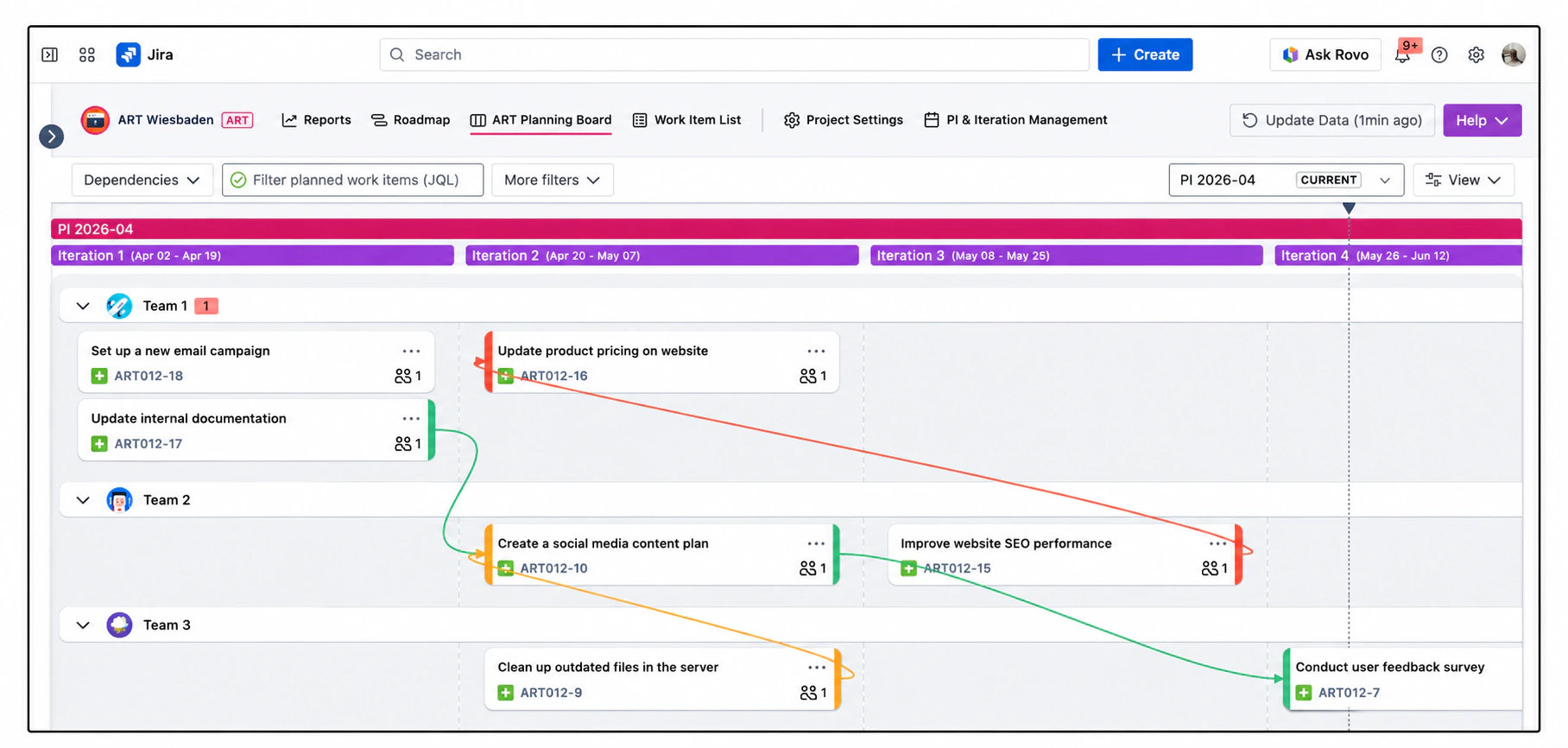
But completing the ART Planning Board isn’t the finish line.
It’s the start of a conversation.
Every dependency represents a story about how work flows through the organization. Some dependencies reflect healthy collaboration between Agile Teams. Others reveal architectural constraints, technical debt, unclear ownership, or organizational structures that create unnecessary coordination.
The ART Planning Board isn’t simply a planning artifact.
It also provides one of the clearest views into how work actually flows across an Agile Release Train.
It’s a snapshot of how your system delivers value.
The question isn’t whether dependencies exist.
The question is what those dependencies are telling you.
Three Stages of Dependency Maturity
Organizations often evolve through three stages as their approach to dependency management matures.
Stage 1: Discover Dependencies
For organizations early in their SAFe journey, visibility is the first major breakthrough.
Teams identify who depends on whom before implementation begins, reducing surprises during the Planning Interval and creating greater confidence in delivery plans.
Stage 2: Coordinate Dependencies
As Agile Release Trains mature, they improve collaboration across teams.
Work is sequenced more effectively. Risks are identified earlier. Ownership becomes clearer. Teams communicate more proactively and coordinate delivery with greater confidence.
This represents meaningful progress.
But many organizations stop here.
Stage 3: Reduce Unnecessary Dependencies
High-performing organizations ask a different question.
Instead of focusing only on coordinating dependencies, they examine why certain dependencies continue to appear every Planning Interval.
That often leads to lasting improvements, such as:
- Organizing teams around value streams instead of technical silos.
- Investing in platform capabilities that remove recurring bottlenecks.
- Improving APIs and system architecture.
- Simplifying governance and approval workflows.
- Addressing technical debt that creates unnecessary coordination.
- Expanding cross-functional skills within Agile Teams.
- Reducing handoffs by clarifying ownership.
Each improvement makes future PI Planning events simpler because fewer teams need to coordinate the same work, allowing value to flow more predictably across the ART.
The Dependency Maturity Cycle
Organizations don’t become more effective because they identify more dependencies.
They become more effective because each Planning Interval teaches them how to reduce unnecessary dependencies before the next one begins.
Reducing Dependencies Improves Flow
This isn’t just a planning philosophy.
Research from Google’s DORA program has consistently found that loosely coupled teams and architectures are associated with stronger software delivery performance. When teams can deliver work with fewer handoffs and less coordination overhead, they are better positioned to respond to change while maintaining a steady flow of value.
That’s why mature organizations don’t view recurring dependencies as unavoidable.
They view them as opportunities to improve how work moves through the system.
Dependencies Are Data
This is the dependency problem that rarely gets discussed.
Most organizations treat dependencies as temporary obstacles that must be managed for the next Planning Interval.
Mature organizations treat them as data.
Every recurring dependency provides insight into how work moves through the organization. Over time, those patterns reveal where architecture can improve, where ownership should change, where automation can remove friction, and where organizational design may need to evolve.
Recurring dependencies aren’t just planning challenges.
They’re feedback about the health of your value streams.
When the same teams become bottlenecks every Planning Interval, or the same approval process slows delivery quarter after quarter, the issue isn’t simply coordination.
The system is telling you where value stops flowing efficiently.
Instead of celebrating that hundreds of dependencies were identified during PI Planning, leaders should ask a different question.
Are we seeing fewer recurring dependencies than we did during our last Planning Interval?
If the answer is no, the challenge may not be the planning process.
It may be the system producing those dependencies.
From Coordination to Continuous Improvement
This perspective changes the purpose of dependency management.
Rather than treating each Planning Interval as an isolated planning event, organizations begin using dependency patterns to guide continuous improvement across their Agile Release Train.
The conversation shifts from:
“How do we manage these dependencies this quarter?”
to:
“Why do these dependencies still exist?”
That single question encourages Release Train Engineers, Product Management, Business Owners, System Architects, Scrum Masters, and Agile Teams to look beyond coordination and toward improving the system itself.
Over time, the result is more predictable delivery, stronger alignment, healthier value streams, greater team autonomy, improved flow metrics, and less time spent coordinating work that could have been simplified or eliminated altogether.
How Agile Hive Helps
Agile Hive helps organizations visualize dependencies during PI Planning, providing a shared view of cross-team coordination directly within Jira.
Visibility is important.
Learning from that visibility is where lasting improvement begins.
When Agile Release Trains identify recurring dependency patterns across multiple Planning Intervals, they gain valuable insight into where friction exists within their value streams. Those conversations help teams improve alignment, remove friction from value delivery, reduce unnecessary coordination, and strengthen the flow of value across the organization.
Dependency management isn’t just about keeping work on schedule.
It’s about delivering value more predictably by building systems that become simpler, more resilient, and easier to coordinate with every Planning Interval.
Conclusion
Dependencies are an unavoidable part of delivering complex products at scale.
Recurring dependencies don’t have to be.
The next time your teams gather around the ART Planning Board, don’t just ask whether every dependency has an owner.
Ask which of those dependencies shouldn’t exist when you gather for your next PI Planning event.
Every recurring dependency is more than a planning challenge.
It’s feedback about how work flows through your organization.
Organizations that embrace that feedback don’t just get better at PI Planning.
They build healthier value streams, improve flow across the ART, and deliver value with greater confidence every Planning Interval.
Make Dependencies Visible. Make Improvement Possible.
See how Agile Hive helps Agile Release Trains visualize cross-team dependencies and coordinate PI Planning directly in Jira.